JMT – Bentley ProjectWise Implementation
Overview
In late 2019, JMT’s project delivery relied heavily on network file shares—an approach that created security exposure, inhibited cross-office collaboration, and constrained remote work. I was asked to spearhead a firm-wide digital transformation initiative centered on Bentley ProjectWise, with the goals of strengthening information security, enabling real-time collaboration, and building a BIM-aligned governance model across disciplines.
Result: Within 18 months, we transitioned priority business units across Texas, Virginia, and Pennsylvania onto ProjectWise, then scaled firm-wide as the pandemic accelerated demand for remote access and coordination. The program established a secure, standards-driven project ecosystem supporting 20+ disciplines and integrated platforms like OpenRoads, OpenBridge, Civil 3D, and Revit.
Business Challenge
- Security Risk: Network file shares lacked granular permissions, auditability, and consistent access controls, creating vulnerabilities and compliance gaps.
- Collaboration Bottlenecks: Multi-office teams and sub-consultants struggled with file copies, version confusion, and delayed coordination—leading to surprises and rework.
- Operational Resilience: The onset of COVID-19 required a rapid shift to secure remote work and real-time collaboration without compromising standards or project schedules.
My Role
- Program Lead & Architect: Defined the enterprise roadmap, implementation blueprint, and change management strategy; owned stakeholder alignment and executive communication.
- Phased Rollout Manager: Orchestrated deployments starting in Texas and Virginia (2019–2020), expanding to Pennsylvania late 2020, then scaling across the firm.
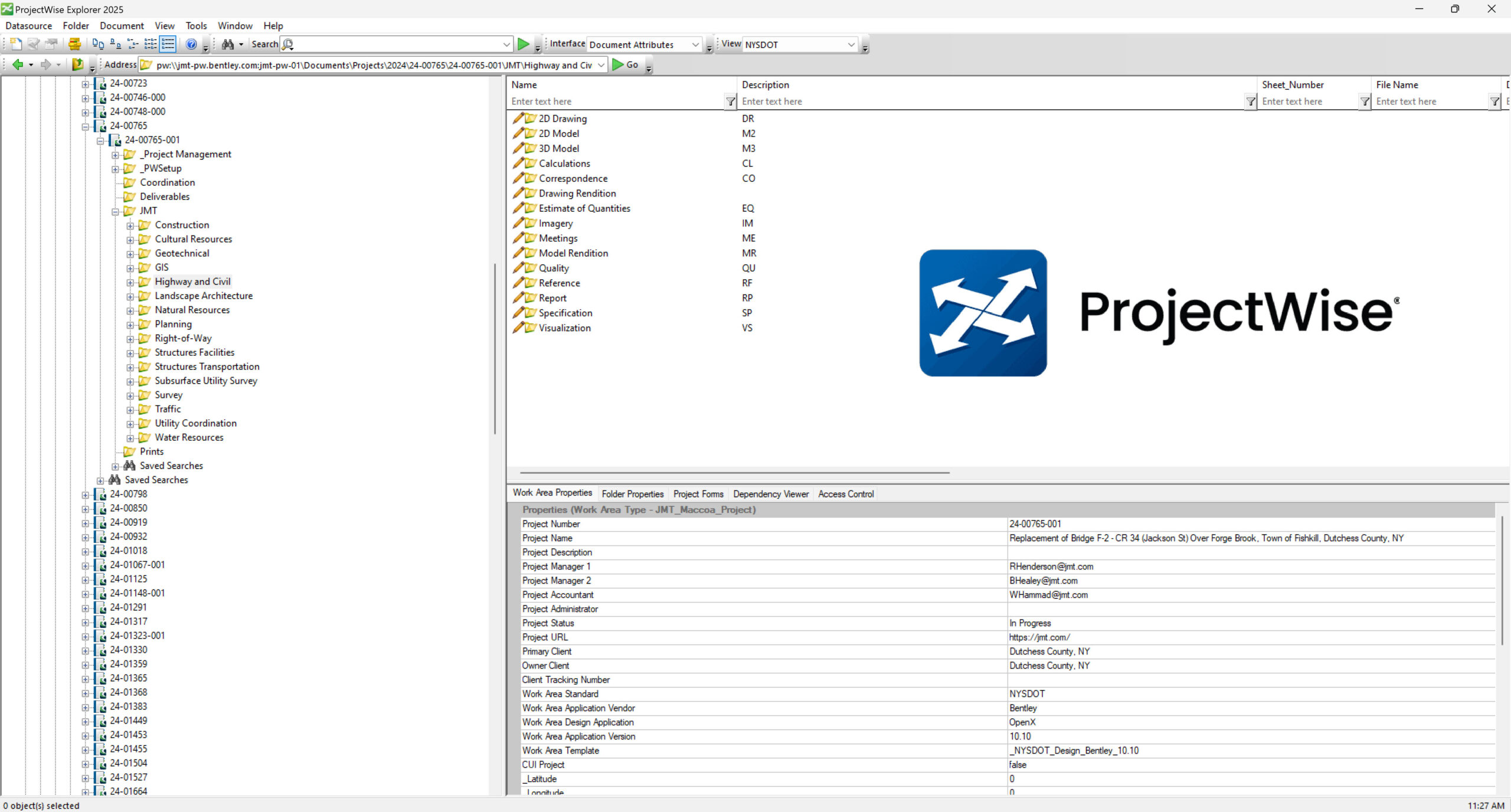
- Governance Designer: Built an ISO 19650–modeled document environment with standardized work area properties, folder structures, document coding, metadata, and access controls.
- Technical Integrator: Led the integration and conflict resolution between intelligent (model-based) and non-intelligent (document-based) design files across OpenRoads/OpenBridge/Civil 3D.
- Adoption Champion: Delivered training, pilot projects, playbooks, and support structures to embed new behaviors and make ProjectWise the trusted “single source of truth.”
Approach
- Risk-Driven Strategy
- Prioritized high-visibility, high-risk programs for early migration.
- Implemented least-privilege access and auditable workflows to reduce exposure.
- Collaboration-First Design
- Enabled secure external collaboration with sub-consultants—live access to current files, controlled sharing, and elimination of uncontrolled copies.
- Instituted discipline-specific workflows (e.g., civil vs. structures vs. buildings) while preserving enterprise standards.
- ISO 19650–Modeled Governance
- Standardized folder taxonomy, document naming/coding, metadata, and status codes.
- Defined roles and permissions aligned with responsibilities and deliverable states (Work-in-Progress, Shared, Published, Archived).
- Technical Integration
- Mapped application-specific dependencies (e.g., reference/link management, file locking, versioning).
- Resolved conflicts between intelligent model files and non-intelligent documents to maintain consistency in federated designs.
- Change Management
- Established pilot teams and “champion” networks.
- Built trainings, SOPs, and quick-start guides tailored to each discipline and project type.
- Created feedback loops and continuous improvement cadence.
Implementation Timeline
- Q4 2019 — Program charter; tool selection; Texas/Virginia pilots launched.
- Q1–Q3 2020 — Governance framework finalized; priority projects migrated; remote collaboration surge during pandemic.
- Q4 2020 — Pennsylvania rollout; cross-discipline SOPs standardized; external collaboration playbooks formalized.
- 2021 onward — Firm-wide adoption; refinement of discipline-specific templates; continuous optimization and archival strategy.
Key Design Decisions
- Single Source of Truth: Enforced storage in ProjectWise (no shadow drives) with controlled external access and reference integrity.
- Auditability: clear status transitions to support recordkeeping and design traceability.
- Federated, Not Fragmented: Ensured references across OpenRoads/OpenBridge/Civil 3D remained consistent and governable, reducing broken links and rework.
- Standards with Flexibility: Enterprise governance with configurable discipline layers, so teams could move fast without breaking rules.
Outcomes
- Risk Mitigation
- Reduced exposure from unmanaged file shares via granular permissions, file locking, and access auditing.
- Improved compliance posture with traceable document history and controlled publishing.
- Collaboration
- Real-time coordination with sub-consultants; reductions in rework and “surprise” changes.
- Faster multi-office delivery with shared context across 20+ disciplines.
- Operational Resilience
- Seamless remote access during pandemic conditions, maintaining productivity and project schedules.
- Quality & Consistency
- Standardized document environment aligned to ISO 19650 principles across the enterprise.
- Managed Workspace and Profiles for consistent work environments across teams
Metrics :
- 60–80% reduction in uncontrolled file copies on priority programs.
- 30–50% faster external handoffs due to controlled sharing and current-reference access.
- Near-zero incidents of “lost work” from overwrite conflicts after file locking policies.
- Consistent application of data structure and standards across 20+ disciplines within 12 months.
Lessons Learned
- Governance Is a Product: Treat standards like living assets—iterate based on project feedback.
- Pilots Build Momentum: Early wins in targeted offices created champions and accelerated adoption.
- Integration Details Matter: Reference management and application-specific behaviors (especially across civil and building tools) are make-or-break.
- Change Management Is Continuous: Training, office hours, and peer networks are as critical as technical setup.
What I’m Proud Of
I architected and led a transformation that made JMT’s project delivery more secure, more collaborative, and more resilient. By aligning governance, technology, and behavior change, we turned ProjectWise into the firm’s backbone for coordinated design and reliable recordkeeping—especially when remote work became essential.